
Compassionate judgment,
practiced into instinct.
Readiness Empowered.
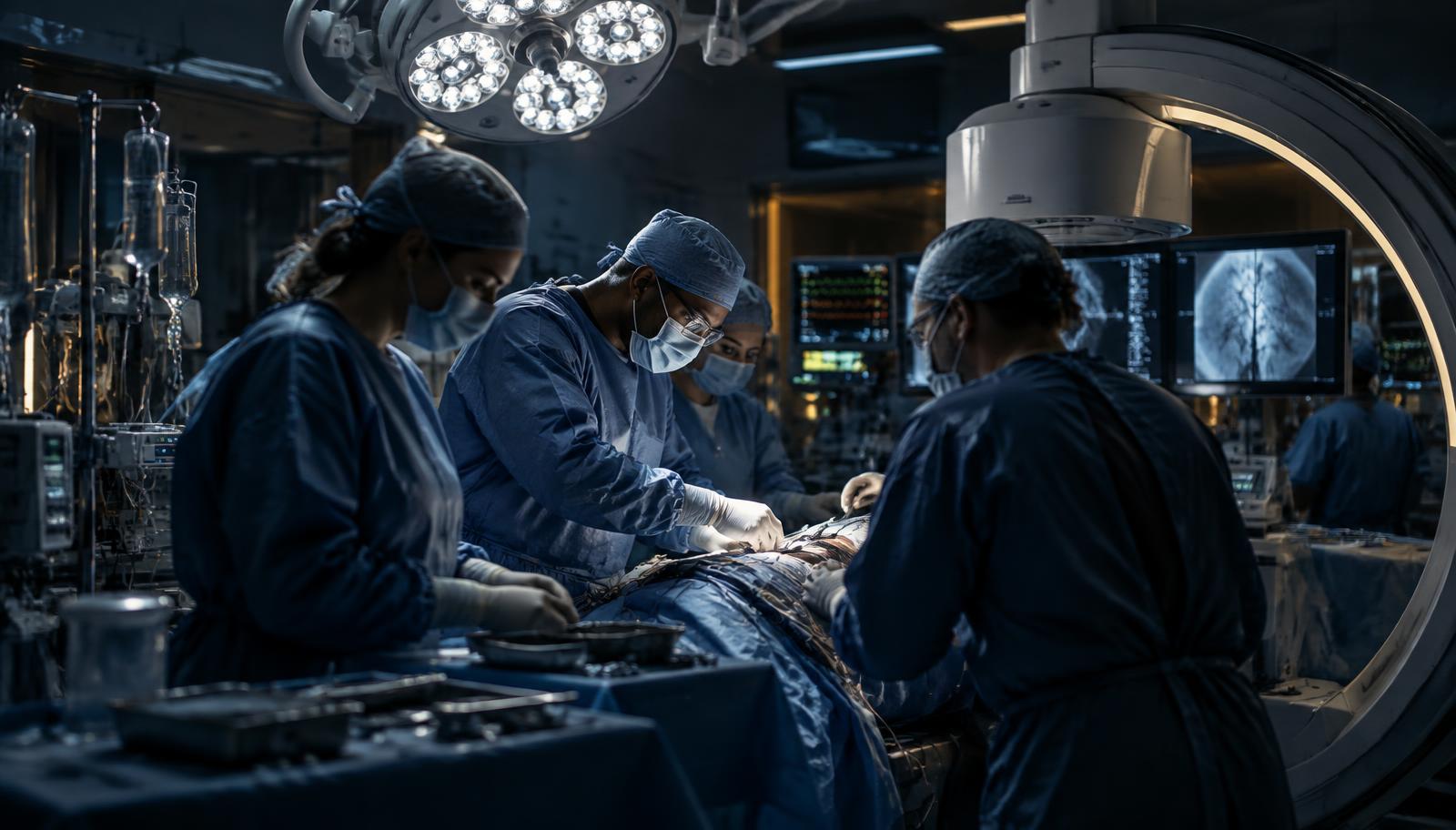
From bedside to operating theatre, Infiniqo delivers clinical simulation training and healthcare simulation that recreates the conditions where every decision counts — building the calm, precision and empathy patients trust.
Buyer profiles
Built for the people on the line.
For the educators and simulation leaders who shape how the next generation of clinicians decides under pressure.
Outcomes
What changes.
Every Infiniqo engagement is engineered around outcomes you can defend in front of a board, an inspector, or your own conscience.
I
Patient Safety
Reduce preventable error through deliberate, measured rehearsal.
II
Clinical Confidence
Bring novice clinicians to journeyman judgment, faster and safer.
III
Team Communication
Strengthen the handoffs and escalations that protect outcomes.
IV
Compassion at Capacity
Sustain humane care even under operational strain.
Scenarios
A sample of the work.
- 01Mass casualty triage and ED surge
- 02Code blue and rapid response coordination
- 03Surgical complication management
- 04Difficult family conversations and end-of-life care
- 05Dental procedural mastery in virtual patient environments
Frequently asked
Questions, answered.
Question 01
What clinical disciplines do you support?
We cover acute care, perioperative, emergency medicine, primary care, mental health and dental specialities. Each simulation is authored with domain-specific clinical educators who understand the protocols, vocabulary and emotional texture of that environment.
Question 02
How does simulation training compare to traditional methods?
Traditional training transfers knowledge; simulation transfers judgment under uncertainty. Learners remember what they felt, not just what they heard. Our data shows retention curves that are roughly three times longer for experiential versus lecture-based instruction.
Question 03
Can you integrate with our existing LMS or EHR?
Yes. We publish SCORM and xAPI packages that drop into Moodle, Canvas, Blackboard and most major health-system learning platforms. We also offer FHIR-adjacent data overlays for EHR-integrated scenarios where appropriate.
Question 04
What evidence do you provide for accreditation bodies?
Every session generates a competency transcript: actions taken, decisions timed, communication markers and reflection summaries. These maps align with GMC, NMC, ACGME and Joint Commission competency frameworks.
Question 05
How do you measure competency improvement?
We baseline each cohort with a diagnostic scenario, then remeasure with an equivalent form after the curriculum. The delta is reported as a composite score plus sub-scores for clinical reasoning, teamwork, communication and ethical reasoning.
Question 06
Is this suitable for continuing education credits?
Absolutely. Our curricula are CPD-accredited in the UK and carry CEU eligibility in North America. We handle the administrative workflow — certificates, hour logs and reporting — so your professional development office does not have to.
Question 07
What scenarios are covered?
Representative scenarios include: Mass casualty triage and ED surge; Code blue and rapid response coordination; Surgical complication management; Difficult family conversations and end-of-life care; Dental procedural mastery in virtual patient environments.
- We cover acute care, perioperative, emergency medicine, primary care, mental health and dental specialities. Each simulation is authored with domain-specific clinical educators who understand the protocols, vocabulary and emotional texture of that environment.
- Traditional training transfers knowledge; simulation transfers judgment under uncertainty. Learners remember what they felt, not just what they heard. Our data shows retention curves that are roughly three times longer for experiential versus lecture-based instruction.
- Yes. We publish SCORM and xAPI packages that drop into Moodle, Canvas, Blackboard and most major health-system learning platforms. We also offer FHIR-adjacent data overlays for EHR-integrated scenarios where appropriate.
- Every session generates a competency transcript: actions taken, decisions timed, communication markers and reflection summaries. These maps align with GMC, NMC, ACGME and Joint Commission competency frameworks.
- We baseline each cohort with a diagnostic scenario, then remeasure with an equivalent form after the curriculum. The delta is reported as a composite score plus sub-scores for clinical reasoning, teamwork, communication and ethical reasoning.
- Absolutely. Our curricula are CPD-accredited in the UK and carry CEU eligibility in North America. We handle the administrative workflow — certificates, hour logs and reporting — so your professional development office does not have to.
- Representative scenarios include: Mass casualty triage and ED surge; Code blue and rapid response coordination; Surgical complication management; Difficult family conversations and end-of-life care; Dental procedural mastery in virtual patient environments.